
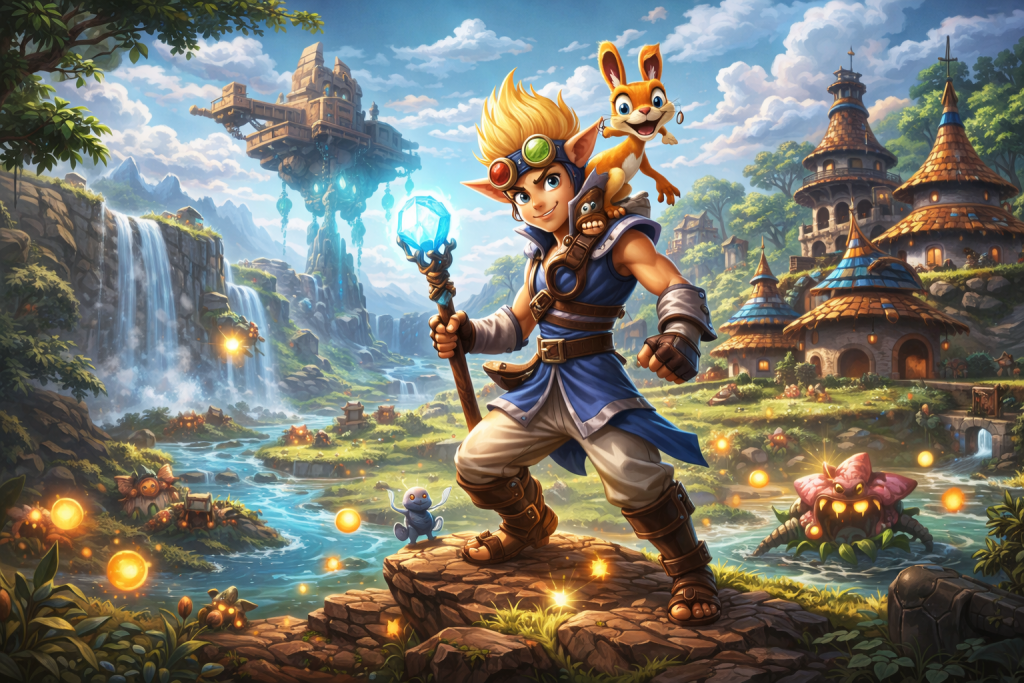
SI-generated
Jak and Daxter: The Precursor Legacy is a 3D platformer developed by Naughty Dog and published by Sony Computer Entertainment for the PlayStation 2 in 2001. Players control Jak, a young hero, and his transformed ottsel companion Daxter as they explore a vast interconnected world to reverse Daxter's transformation and uncover the secrets of the ancient Precursor civilization. The game is celebrated for its seamless world design, engaging platforming, vibrant visuals, and technical achievements that pushed the PS2 hardware to its limits.
Notable Facts
- **Seamless Open World**: Featured a completely seamless world with no loading screens between areas, a groundbreaking technical achievement for the PS2 era that created an unprecedented sense of exploration and immersion
- **Naughty Dog's PS2 Debut**: Marked Naughty Dog's transition from Crash Bandicoot on PlayStation 1 to the PS2, showcasing their evolution in game design and technical prowess
- **Custom Game Engine**: Built on a custom Lisp-based engine called GOAL (Game Oriented Assembly Lisp), allowing for dynamic code modification and optimization during development
- **Eco Power System**: Introduced colored Eco energy (Green, Blue, Red, Yellow) that granted temporary abilities, adding strategic depth to combat and exploration
- **Precursor Orb Collection**: Featured 2000 collectible Precursor Orbs hidden throughout the world, encouraging thorough exploration and rewarding completionists
- **Dynamic Duo**: Jak (silent protagonist) and Daxter (talkative ottsel) created a memorable partnership with excellent character chemistry and humor
- **Critical Acclaim**: Received widespread praise for its technical achievements, world design, and platforming, winning multiple Game of the Year awards
- **Franchise Foundation**: Launched a successful franchise with sequels that evolved into darker, more action-oriented games (Jak II, Jak 3, Jak X)
- **Visual Excellence**: Showcased stunning graphics with vibrant colors, detailed environments, and smooth animation that demonstrated the PS2's capabilities
- **Interconnected World Design**: Each area connected naturally to others, creating a cohesive world that players could traverse freely without artificial barriers, influencing future open-world platformer design